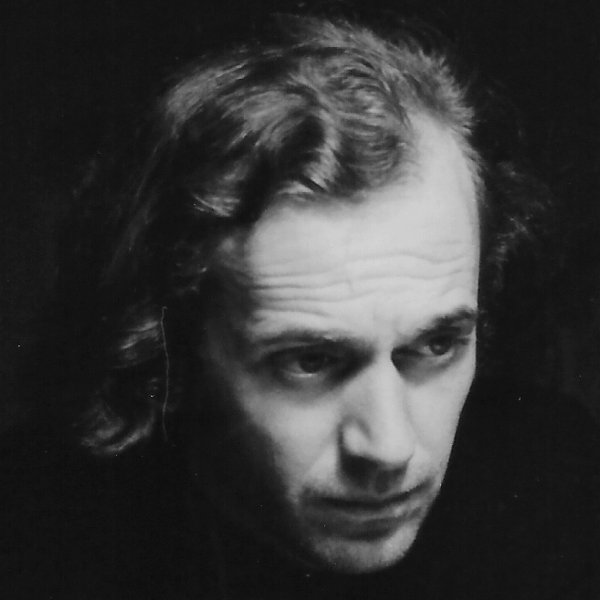
He was born in 1939 in Athens, where he also died in 1994. During 1958-1960 he lived in Paris. He first exhibited his work in a solo show in 1961, in Athens. Throughout his life Akrithakis was connected in deep friendship with writers and poets, with whom he collaborated systematically. In 1968 he moved to Berlin after winning a scholarship from D.A.A.D. (The German Academic Exchange Service). The years 1967-1984 were spent living and working between Berlin and Athens where he was always inspired. During the 1970s he collaborated with the gallerist Alexander Iolas and his work was exhibited internationally. In 1984 he returned permanently to Greece. His body of work consists mainly of paintings, constructions and drawings, as well as artists’ books, furniture designs and scenography projects.
Alexis Akrithakis
Works


Solo Exhibitions
2026
Alexis Akrithakis. A Line like a Wave •
Benaki Museum•
Athens•
(curated by Chloe Akrithaki and Alexios Papazacharias)•
2019
Alexis Akrithakis: On the Move. From the Zacharias G. Portalakis Art Collection •
Historical Museum of Crete•
Heraklion•
(curated by Denise-Chloe Alevizou, Angeliki Baltatzi, Despina Pertselaki)•
2018
Alexis Akrithakis’s Stories •
Athens Municipality Arts Centre (Parko Eleftherias)•
Athens•
2017
This Drawing Is Wrong •
Cask Gallery•
Larissa•
2015
Mykonos Annex of the Fine Arts School of Athens•
Mykonos•
2011
Kalfayan Galleries•
Thessaloniki•
2010
Kalfayan Galleries•
Athens•
2008
Kalfayan Galleries•
Athens•
2006
A … as for Akrithakis •
Museum of Cycladic Art•
Athens•
2005
Kalfayan Galleries•
Athens•
2004
Portalakis Collection•
Athens•
2003
Neue Nationalgalerie•
Berlin•
1998
National Gallery – Alexandros Soutsos Museum•
Athens•
1997
Macedonian Museum of Contemporary Art (MOMus – Museum of Contemporary Art)•
Thessaloniki•
1993
Ileana Tounta Contemporary Art Center•
Athens•
1992
Monsters •
Kreonidis Gallery•
Athens•
1991
Magnifications •
Miraraki Art Gallery•
Athens•
1990
Flowers for My Suicide Friends •
Gallery Zalokosta 7 (Gallery 7)•
Athens•
1990
Epikentro Contemporary Art Center•
Patras•
1989
Opsis Art Gallery•
Mykonos•
1989
Ioni Gallery•
Kifissia•
1988
Drawings •
Athens Art Gallery•
Athens•
1987
Cirk – Collages •
Artio Gallery•
Athens•
1986
Circus •
Artio Gallery•
Athens•
1985
Kites •
Artio Gallery•
Athens•
1984
The Polyphemus Hydroelectric Works •
Antinor Gallery•
Athens•
1984
Institut Français d’Athènes•
Thessaloniki•
1984
Epiloges Art Gallery•
Athens•
1984
Artio Gallery•
Athens•
1983
Karen & Jean Bernier Gallery (Bernier / Eliades Gallery)•
Athens•
1981
Karen & Jean Bernier Gallery (Bernier / Eliades Gallery)•
Athens•
1980
Ionia Gallery•
Athens•
1980
Medusa Art Gallery•
Athens•
1979
Collages ’79 •
Design Market•
Thessaloniki•
1978
Trito Mati Gallery•
Athens•
1978
Galerie Skulima•
Berlin•
1977
Zita-Mi Art Gallery•
Thessaloniki•
1977
Projects and Drawings •
Karen & Jean Bernier Gallery (Bernier / Eliades Gallery)•
Athens•
1974
Galerie Tanit•
Munich•
1973
Galleria Il Fauno Due •
Turin•
(in collaboration with Galleria Iolas-Galatea, Milan)•
1973
Kochlias Art Gallery•
Thessaloniki•
1973
Galleria Iolas-Galatea•
Milan•
1973
Zoumboulakis Galleries•
Athens•
1972
Galerie Niepel•
Düsseldorf•
1972
Galleria Di Leone•
Venice•
1971
Alexandre Iolas Galleries•
Geneva•
1971
Zita-Mi Art Gallery•
Thessaloniki•
1971
Zoumboulakis Galleries•
Athens•
(in collaboration with D.A.A.D. and Alexandre Iolas Galleries)•
1970
Galerie Ubu•
Karlsruhe•
1970
Decorative Arts Workshop•
Athens•
1969
Galerie Mikro•
Berlin•
1969
Galerie Junge Generation•
Hamburg•
1968
Temperas and Inks •
Goethe Institute•
Athens•
(in collaboration with D.A.A.D.)•
1967
Amalia Hotel•
Athens•
1967
Galerie Hammer-Europa Center•
Berlin•
1966
Clio Gallery•
Thessaloniki•
1965
Institut Français d’Athènes•
Athens•
1963
Veltsos Gallery•
Thessaloniki•
1961
Municipality of Neo Heraklion, Cultural Centre•
Neo Heraklion•
2026
2019
2018
2017
2015
2011
2010
2008
2006
2005
2004
2003
1998
1997
1993
1992
1991
1990
1990
1989
1989
1988
1987
1986
1985
1984
1984
1984
1984
1983
1981
1980
1980
1979
1978
1978
1977
1977
1974
1973
1973
1973
1973
1972
1972
1971
1971
1971
1970
1970
1969
1969
1968
1967
1967
1966
1965
1963
1961
Press
From the mid-1960s, when it would be safe to say that you could now see in his works the Alexis Akrithakis that you recognise, Akrithakis entered the world of art from the front door, as a new proposition, fresh and disarmingly direct. In his case, the term “self-taught” does not mean unlucky, or isolated, or amateur, but determined. His determination, which is combined with daring, inquisitiveness and total honesty, reverberates across the entire range of a consistent, abundant, and pluralistic body of work, which extends over three decades and comes to an abrupt end with the artist’s untimely death in 1994. His artistic expression, unique, resists categorisation, often flirting with movements and terms such as pop art, abstract expressionism, geometrical abstraction, nouveau réalisme, art informel, the arte povera of his time, without really ever fitting in any of them, with his distinctive style branching out to different media and gestures. In an attempt to crudely divide his work, the entirety of his oeuvre can be divided in two major categories: small works on paper, and large works, which are generally paintings on canvas or wood and structures made, mostly, of wood. His works on paper, albeit smaller in size, preoccupied and were systematically produced by the artist, from the moment he recognised the artist within himself, which happened as early as his school years. From then onwards and until the end of his life, his characteristic style developed into countless sheets of paper, onto which spun the “tsiki-tsiki” and hearts, arrows, strange trees, labyrinths, suitcases, poisonous monsters, boats, mysterious figures and flowers appeared, in various combinations, along with doodles, secret alphabets and texts. His painting graduated from the first large gouache works on paper of the 1960s to oil and canvasses and, of course, the wooden constructions that maintained the characteristic full-frontal nature of his works. Direct, and facing the viewer head-on, the distinct shapes and brilliant colours of his works are placed either by brush and oil on paper, or by nail and acrylic on wood, and become engraved in memory, powerfully and permanently. The forms, like stories and like tragic subjects, exist in Akrithakis’s work in a profoundly existential interpretation of painting, far removed from any kind of academicism.
Alexios Papazacharias, 2019