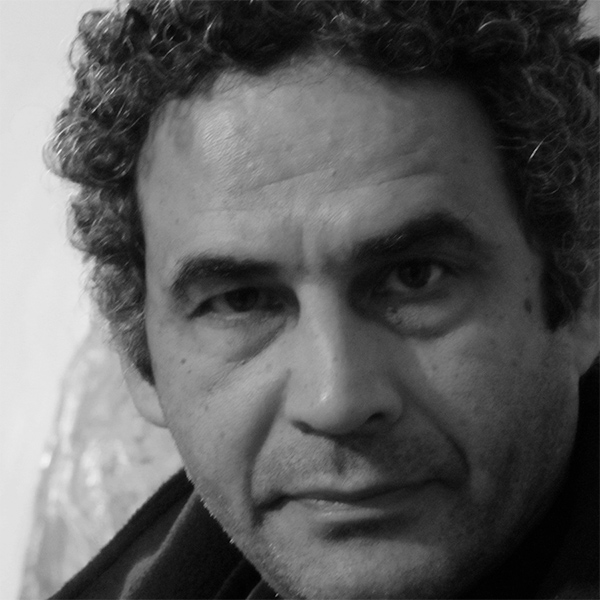
Born in Kalamata in 1955, he was an Athens School of Fine Arts student (1975-1980) of Yannis Moralis; he continued his studies at the École nationale supérieure des Beaux-Arts in Paris (1980-1982). His works can be found in museums and private collections. He lives and works in Athens.
Thanassis Makris
Works


On Art and His Art: Thanassis Makris
The painter Thanassis Makris describes his relationship with art as his attempt to interpret his awe before the world that surrounds him. He describes the creative process he follows through the making of a work, the external stimuli he receives and the references to them, all the way to the final work. He characterises the gaze of Sotiris Felios as hellenocentric and anthropocentric, and talks of his work Landscape, which is part of the collection. Explaining his need to preserve the autonomy of forms while composing an image, he points out that his primary aim is to show himself through each of his works, rather than their individual subject matters.
Solo Exhibitions
2026
Waves •
Municipal Art Gallery of Alimos•
Athens•
curated by George Mylonas•
2024
solo exhibition •
A Touch of New/Vacation House Aspalathos•
Tinos island•
curated by Skoufa Gallery•
2023
Thanassis Makris' Idols •
Skoufa Gallery•
Athens•
2021
Thanassis Makris •
National Library of Greece Stavros Niarhos Cultural Centre•
Athens•
2020
Thanassis Makris •
Skoufa Gallery•
Athens•
2018
The Landscape – An Inexplicable Universe •
Ekfrasi – Yianna Grammatopoulou Gallery•
Athens•
2017
Maria Kallas, Drawings •
National Bank of Greece Cultural Foundation•
Athens•
2016
The Dominance of the Temporary •
Ekfrasi – Yianna Grammatopoulou Gallery•
Athens•
2012
Thanassis Makris: A Retrospective •
Frissiras Museum•
Athens•
2011
Landscape Nude •
Ekfrasi – Yianna Grammatopoulou Gallery•
Athens•
2008
Moschandreou Gallery•
Missolonghi•
2008
Epsilon Art Gallery•
Thessaloniki•
2007
Tzamia-Krystalla Art Gallery•
Chania•
2006
Painting •
Ekfrasi – Yianna Grammatopoulou Gallery•
Athens•
2004
Studies •
Ekfrasi – Yianna Grammatopoulou Gallery•
Athens•
2002
Ekfrasi – Yianna Grammatopoulou Gallery•
Athens•
2000
Chryssa Gallery•
Katerini•
2000
Chyssothemis Art Gallery•
Athens•
1998
Athens Art Gallery•
Athens•
1997
Ekfrasi – Yianna Grammatopoulou Gallery•
Athens•
1994
Athens Art Gallery•
Athens•
1993
Miranda Art Gallery•
Hydra•
1991
Ekfrasi – Yianna Grammatopoulou Gallery•
Athens•
1991
Municipal Art Gallery of Kalamata, "A. Tassos"•
Kalamata•
1990
Titanium Gallery (Titanium Yiayiannos Gallery)•
Athens•
1986
Ora Art and Cultural Centre•
Athens•
1984
Ora Art and Cultural Centre•
Athens•
Press
Thanassis Makris
What makes an immediate impression in these paintings by Makris is the colour, in varying hues and shades, applied thickly like clay to the canvas. The onlooker has the sense that this is some pulsating, ‘living’ material which sometimes stands out because of the layout and structure of the specific painting, but in other cases becomes a rich, restless colour as the journey of creative foment continues.
The “Missolonghi” this artist paints is a Missolonghi of small, isolated structures, be they houses or huts, in a horizontal landscape dominated by earthy and watery hues; the paintings appear to have been composed around some central axis with a upper and lower part, suggesting that in the middle lies the water and the reflection commences from there.
These are dynamic paintings, filled with passionate colour and a romantic artistic spirit, which seek to unite the artistic form with the emotional force underlying them, using thickly-applied paint as the medium for this; paint which is well worked on the pallet as an explosive mix of multiple colours, which with every brushstroke reveals its inner composition.
Makris has been acclaimed for many years now for his painting, and now utilises the inspiration from the unique landscape of Missolonghi to tailor his own unique style to the inspiration drawn from this landscape.
These are the works of a mature artist; works deeply personal to the artist. They are also on a par with are major painters from the start of the 20th century, such as N. Lytras and M. Economou, in whose footsteps he is a worthy follower.
Haris Kambouridis