Born in Chania (Crete) in 1953, he was an Athens School of Fine Arts student of Dimosthenis Kokkinidis (1979-1984). In 1994, along with Marios Spiliopoulos, Antonis Michailidis, Vicky Tsalamata and Edouard Sacaillan, they won the Alexandria Biennale award for best National Pavilion. He has been teaching at the Athens School of Fine Arts from 1987 to 2026 and was appointed Professor of Painting in 2014. Works by him can be found in important public and private collections. He lives and works in Athens.
Michalis Manoussakis

Works




On Art and His Art: Michalis Manoussakis
The painter Michalis Manousakis recites, in a poetic mood, a short piece that he has written, and describes the gaze of Sotiris Felios as erotic and human. He talks of his work Untitled, where he renders the existential dimension of the human figure and the world as memory. In speaking, finally, of the function of art as a primary need of man for communication, he underlines his aspiration to constantly redefine the world and man through his works.
Solo Exhibitions
2025
Eternal Bodies, Mortal Flesh •
Alpha C.K. Art Gallery•
Nicosia, Cyprus•
2025
Art Intelligence. A Retrospective like half a breath •
retrospective exhibition•
Athens School of Fine Arts•
Athens•
2023
The land of "once upon a time" - Heroes being in the trash •
Municipal Art Gallery of Chania•
Chania•
2022
Children's Museums •
Ekfrasi – Yianna Grammatopoulou Gallery•
Athens•
2020
Landscapes of Salt in the Evening •
Ekfrasi – Yianna Grammatopoulou Gallery•
Athens•
2019
Memory Fragments •
Alpha C.K. Art Gallery•
Athens•
2017
Her Long Hair, a Shadowy Breeze •
Ekfrasi – Yianna Grammatopoulou Gallery•
Athens•
2016
Chania Ephorate of Antiquities, Splantzia Square, Turkish Fountain•
Chania•
2016
Heroes in the Trash •
Athens School of Fine Arts, Nikos Kessanlis Hall•
Athens•
2015
Born in Chania in 1953 •
Ekfrasi – Yianna Grammatopoulou Gallery•
Athens•
2012
One Meter •
National Museum of Contemporary Art (EMST)•
Athens•
2011
The Space of Time •
Retrospective exhibition•
Municipal Art Gallery of Chania•
Chania•
2010
The Reason Still Remains Unknown •
Apocalypse Gallery•
Nicosia•
2008
Michalis Manoussakis 2003-2008 •
Ekfrasi – Fizz Galleries•
Athens•
2008
Citronne Gallery•
Poros•
2007
Perfect Tense •
Falatados School•
Tinos•
2006
Artforum Gallery•
Thessaloniki•
2006
C.K. Art Gallery (Alpha C.K. Art Gallery)•
Nicosia•
2006
Nees Morfes Gallery•
Athens•
2002
Little Prayers •
Artforum Gallery•
Thessaloniki•
2001
Rossi & Rossi Gallery•
London•
2001
Zoumboulakis Galleries•
Athens•
2000
Opus Gallery•
Nicosia•
1998
Parallel Worlds •
Zoumboulakis Galleries•
Athens•
1996
Artforum Gallery•
Thessaloniki•
1995
Titanium Gallery (Titanium Yiayiannos Gallery)•
Athens•
1993
Europ Art•
Geneva•
1992
Titanium Gallery (Titanium Yiayiannos Gallery)•
Athens•
1990
Mylonoyanni Art Gallery•
Chania•
1989
Titanium Gallery (Titanium Yiayiannos Gallery)•
Athens•
1986
Ora Art and Cultural Centre•
Athens•
1979
Diagonios Gallery•
Thessaloniki•
2025
Eternal Bodies, Mortal Flesh •
Alpha C.K. Art Gallery•
Nicosia, Cyprus•
2025
Art Intelligence. A Retrospective like half a breath •
retrospective exhibition•
Athens School of Fine Arts•
Athens•
2023
The land of "once upon a time" - Heroes being in the trash •
Municipal Art Gallery of Chania•
Chania•
2022
Children's Museums •
Ekfrasi – Yianna Grammatopoulou Gallery•
Athens•
2020
Landscapes of Salt in the Evening •
Ekfrasi – Yianna Grammatopoulou Gallery•
Athens•
2019
Memory Fragments •
Alpha C.K. Art Gallery•
Athens•
2017
Her Long Hair, a Shadowy Breeze •
Ekfrasi – Yianna Grammatopoulou Gallery•
Athens•
2016
Chania Ephorate of Antiquities, Splantzia Square, Turkish Fountain•
Chania•
2016
Heroes in the Trash •
Athens School of Fine Arts, Nikos Kessanlis Hall•
Athens•
2015
Born in Chania in 1953 •
Ekfrasi – Yianna Grammatopoulou Gallery•
Athens•
2012
One Meter •
National Museum of Contemporary Art (EMST)•
Athens•
2011
The Space of Time •
Retrospective exhibition•
Municipal Art Gallery of Chania•
Chania•
2010
The Reason Still Remains Unknown •
Apocalypse Gallery•
Nicosia•
2008
Michalis Manoussakis 2003-2008 •
Ekfrasi – Fizz Galleries•
Athens•
2008
Citronne Gallery•
Poros•
2007
Perfect Tense •
Falatados School•
Tinos•
2006
Artforum Gallery•
Thessaloniki•
2006
C.K. Art Gallery (Alpha C.K. Art Gallery)•
Nicosia•
2006
Nees Morfes Gallery•
Athens•
2002
Little Prayers •
Artforum Gallery•
Thessaloniki•
2001
Rossi & Rossi Gallery•
London•
2001
Zoumboulakis Galleries•
Athens•
2000
Opus Gallery•
Nicosia•
1998
Parallel Worlds •
Zoumboulakis Galleries•
Athens•
1996
Artforum Gallery•
Thessaloniki•
1995
Titanium Gallery (Titanium Yiayiannos Gallery)•
Athens•
1993
Europ Art•
Geneva•
1992
Titanium Gallery (Titanium Yiayiannos Gallery)•
Athens•
1990
Mylonoyanni Art Gallery•
Chania•
1989
Titanium Gallery (Titanium Yiayiannos Gallery)•
Athens•
1986
Ora Art and Cultural Centre•
Athens•
1979
Diagonios Gallery•
Thessaloniki•
Press
The Riddles of Vision
We accept reality easily,
possibly because we feel that nothing is real.
Jorge Luis Borges, “The Immortal”
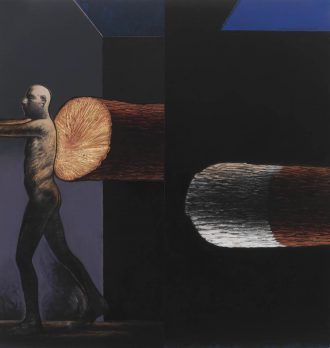
Dangerous balances, Gordian knots, situations that could not exist, paradoxical geometries: A woman clings to (or pushes?) a leaning tree while a string keeps (?) it from falling. Two fishermen’ s lines meet at a clear angle. Optical illusions. Yes, but also a philosophical commentary on the fact that the entire world is one thing. So identical that representation in art (or elsewhere) seems ridiculous or unnecessary. The artist, as a small God who does not observe the external world but creates a system of his own, autonomous from everything else except, possibly, the world of contemplation. More than conceptual formulator, Manoussakis remains an artist who is loyal to the material as well as the meaning of the prototype. In an age that mechanical reproduction should define our notion of art, according to Walter Benjamin, we face a rare exception in which meaning meets the prototype. There, the viewer is puzzled at the decay and revelation of the wood, the traces of carbon on the oil, the contrast of materials and colours. He pokes at the base of the painting as if at human flesh and by taking off its complexion, renders it naked. Clear colour, when it appears, intense, resembles an alien body in the spine of Manoussakis’s reality, usually structured in earthy, melancholic nuances. The artist’s long enduring persistence on mainly tin toys, a form of colorful microsculpture now appears to penetrate his painting. It seems that these precious pieces of another era infiltrate their color into their adjoining works in his studio. It is as if they became live at night, as in Andersen’s fantasy and dyed them their style. He avoids philology as much as impact, keeping the necessary distance from both, in an effort for art to be contemporary, a human creation in a turbulent age. It is intense humanism that characterizes the work of Michalis Manousakis from its beginning and until today, as well as an interest for humble, little things. Agony for man’s condition and art which immediately rejects any pretense of megalomania and impression. His “little man”, usually solitary in the past, here appears to coexist and converse with another, slightly smaller in size, “little man”. Is it because the adolescent is growing up and possibly a new life cycle begins?
Manoussakis constructs his own reality, which, despite its phenomenal similarities, bears little similarity with existing reality. Or, it possibly rewrites the latter in a virtual sphere. The sea of Manoussakis is not exactly sea, the sky is no sky and shadow is no shadow. Here nothing constitutes a representation of reality. The boat we often meet is rather a symbolic arc, destined to carry a couple of people and no means of transportation. The occasional tree, despite its dangerous similarity to the pine, is more of a virtual comrade, a protective roof against the ominous sky. A great part of the works of this exhibition are made of diptychs, which usually constitute two parallel and paradoxically adjoining worlds which are, frequently, mutually cancelled both chromatically as well as conceptually. In one of them, the artist cancels a – genuinely – spontaneous function of vision: voyeurism. Here, we witness a woman in nude from beneath and from the most indiscreet position. In the adjoining part of the work a male figure gazes (at us) from above while shadowing his eyes with his palm, so as not to see. Here the denial of vision as well as of voyeurism function as a metaphor for the indiscreet character of all representation, image, art, as an extension of the Platonic allegory of the cave. Manoussakis seems to converse with a series of artists of the twentieth century. The Surrealists, possibly most of all Magritte, share with him his love of paradoxical situations and of the invention of riddles as well as the very commentary of representation as a lie (we can again recall Magritte’s classic words “Ceci n’est pas une pipe”). Naturally, Marcel Duchamp’s importance as a founder of the conceptual approach to art is projected on the work of Manoussakis. Those who believe that art should incessantly approach society, daily life or even the world of fashion and mass culture might speak of anachronism at this point, (although they are to be confused by the references to post-war toys. But those who believe that art should be a closed, protected system that should exist on a level alien to the trivial facts of daily life and in dialogue with Philosophy and Thinking will here discover the very material that myths are made of.
Thanassis Moutsopoulos