Born in Thessaloniki in 1957, he was an Athens School of Fine Arts student (1976-1981) of Dimitris Mytaras and Yannis Moralis. He pursued his studies in Painting thanks to a Spyridon Vikatos Athens School of Fine Arts scholarship which took him to the Parisian École nationale supérieure des Beaux-Arts where he was taught by Leonardo Cremonini (1984-1987). He has been awarded various painting distinctions: the Prix de l’Académie de Médicine de France (1987), “The Τrophies of Colour, the Lefranc-Bourgeois National Award for Painting” (Lefranc-Bourgeois, Cirque d’Hivers, Paris, 1992), and the Painting Prize at the 18th Biennale of Alexandria (1994). Works by him can be found in Greek and international private and public collections. He resides and works in Athens and in Paris.
Edouard Sacaillan

Works






Solo Exhibitions
2026
From chaos to the world •
Edouard Sacaillan and Anna Maria Tsakali•
Cultural Foundation of Tinos•
Tinos•
(curated by George Mylonas)•
2024
Les toits de Paris •
French Institute of Thessaloniki•
Thessaloniki•
2024
Solo exhibition •
Galerie Minsky•
Paris•
2024
Les toits de Paris •
Kalfayan Galleries•
Athens•
2022
Viewers, audience, white horseman, mob and herd •
Teloglion Foundation for the Arts A.U.TH.•
Thessaloniki•
2021
Spectateurs & Bibelots •
Galerie Minsky•
Paris•
2020
WE •
Kalfayan Galleries•
Athens•
2018
Spectators •
Retrospective exhibition•
Espace Richaud•
Versailles•
2017
Galerie Minsky•
Paris•
2015
Morfi Gallery•
Limassol•
2013
Galerie Lefor Openo•
Paris•
2013
Kalfayan Galleries•
Athens•
2011
Affordable Art Fair •
Galerie Minsky•
New York•
2009
Edouard Sacaillan: The Artist’s Eye •
Frissiras Museum•
Athens•
2008
Spectators •
Kalfayan Galleries•
Thessaloniki•
2008
Viennafair 2008•
Vienna•
(Kalfayan Galleries)•
2007
Utopias of Paradise •
Kalfayan Galleries•
Athens•
2006
Landscapes and People •
Ellinogermaniki Agogi•
Athens•
2005
Spaces with People •
Foundation of Thracian Art and Tradition •
Xanthi•
(Kalfayan Galleries)•
2005
Omikron Gallery•
Nicosia•
2005
Kalfayan Galleries•
Thessaloniki•
2004
Kalfayan Galleries•
Thessaloniki•
2003
Zoumboulakis Galleries•
Athens•
2002
Galerie Lefor Openo•
Paris•
2001
Galerie Le Point•
Monte Carlo•
1999
The Crowd and the Child •
Zoumboulakis Galleries•
Athens•
1997
Terracotta Art Gallery (TinT Gallery)•
Thessaloniki•
1997
Amymoni Art Gallery•
Ioannina•
1996
Mylonoyanni Art Gallery•
Athens•
1996
Le Visage et la Foule •
Galerie Dionne•
Paris•
1995
Chryssa Gallery•
Katerini•
1995
Polyedron Art Gallery•
Patras•
1993
The Crowd and the Child •
Zoumboulakis Galleries•
Athens•
1991
Galerie Arichi•
Paris•
1991
Terracotta Art Gallery (TinT Gallery)•
Thessaloniki•
1990
Galerie Eonnet-Dupuy•
Paris•
1990
Municipal Art Gallery•
Kalamata•
1990
Heraklion Art Gallery•
Heraklion•
1990
Tiryns Gallery•
Karditsa•
1989
Agathi Art Gallery•
Athens•
1988
Ora Art and Cultural Centre•
Athens•
1984
Ora Art and Cultural Centre•
Athens•
1983
Municipal Gallery of Vouliagmeni•
Athens•
2026
2024
2024
2024
2022
2021
2020
2018
2017
2015
2013
2013
2011
2009
2008
2008
2007
2006
2005
2005
2005
2004
2003
2002
2001
1999
1997
1997
1996
1996
1995
1995
1993
1991
1991
1990
1990
1990
1990
1989
1988
1984
1983
Press
The Spectators’ Labyrinth and the Miracle of Lovers in Edouard Sacaillan’s Paintings
The painter is a person who devours
the world with his eyes and gives it
back with his hands. Between his eyes
and hands are his head and
heart, and through them, there is
a kind of digestion and metamorphosis.1
Spectacle – spectator – puppet – aquarium – elevator
Origin – memory – physiognomy – identity
Desire – love – death – paradise
Enclosure – crowding – boredom – sadness – earthquake
The lost body of the society and the poet as existential wreck
We are living in an era where everything is on a massive scale. There is no representation of the subjective. No official language uses art as its truth. The technological image prevents you from recognising the subjectivism of a language; it does not allow us to imagine the different.2
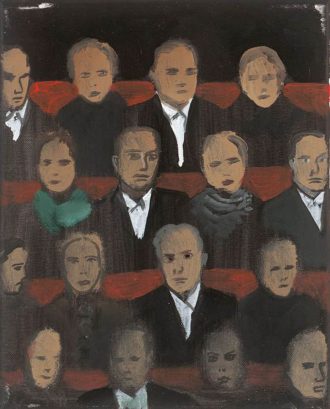
Like the participants in “Big Brother”, Edouard Sacaillan’s multicoloured spectators are enclosed, crowded, and lined up by the painter one beside the other, with no distance between them, but also without interpersonal contact; they watch us as we watch them. And like the reality shows in which people are voluntarily closed up (consciously or unconsciously?) in a place where unknown but similar people co-habit, offering themselves as a spectacle-prey for these other viewers, the armchair peeping toms and cannibals, Sacaillan’s replica people seem to be offering their image, constantly alternating roles with their viewers in a labyrinth that may possibly show them the way out, together with their lost identity.
Like another Shakespearian play within a play,3 but also like the mirror in the Velázquez work which, as Foucault notes, “reflects nothing of what exists in the same room with it, but restores visibility in whatever remains outside the range of any vision”,4 the works of Sacaillan “do not function”, as he himself says, “as rooms, but as mirrors in which all of us who look at them can fit”.5 Thus, the mirror of the Spanish kings, but also the painter’s reversed easel in Sacaillan’s work, seems to become the figures of the viewers themselves that alternate with our own, observing us while we observe them, like that invisible point on a painting which, in both cases, wishes to reveal something. Something that, by extension, has to do with individuality, differentiation, the tragic condition of contemporary civilisation, the strange, the absurd, but also the miraculous. This is why the multi-colour, which is at the same time the multi-sound, of Sacaillan’s work – this labyrinthine visual surface that reveals labyrinthine spaces, within which similar but never identical people are crowded, confined, gathered together and in the end closed in – appears ultimately to play the role of the mirror in his work, which is that of the “broken mirror”, as he calls it, implying “his misgivings about stereotypes”, while pointing out “the fragmentary nature of the image”.6 Something that has to do both with the invisible point at which those we observe become ourselves, as well as with the broader dimension of absence, or rather of Lacanian “trauma” that affects the lost “encounter with the real”.7
It is precisely this lost encounter with the real that the artist seems to suggest when he points out the specific difference between painting and photography, but also when he speaks of “the problem of depicting man”, explaining that the “depiction is what makes man massproduced”.8 This may also be the reason why, in his observation that “people must look at themselves”,9 we in turn should seek the same role, not only of his multicoloured viewers, but also of the shop window – which either exists, such as in “Elevator”, “Cars”, “Working at Computers” or “Audiences at an Audiovisual Assembly”, or is a non-existent or rather invisible façade, as in “Evening Stroll”, “Ship’s Passengers”, “Children Viewers” and “Schoolgirls and kaleidoscope”. This transparent glass window of shops, restaurants, cars and elevators, like another “screen projecting both the confusion of the imaginary and the conditions of enclosure”, also reveals all these “human replicas, i.e. shop window dummies or funfair puppets, that function as models and frequently create inhuman impressions and desires”.10 Thus we could argue that the shop window further underlines the significance of depiction of the image as well as that of the viewers; those who inhabit the works and, as the artist says, “whose environment is the others”,11 but also those who, “as viewers and peeping toms, discover that they are being watched by the faces in the painting”, as Moutsopoulos points out,12 and gradually become aware that they are being led to a different kind of viewing, which this time has to do rather with self-observation through the figure of the other who resembles me, who drives a similar car, who stands in queues, who is trapped in traffic congestion, in movie theatres, on the ship or in the countryside.
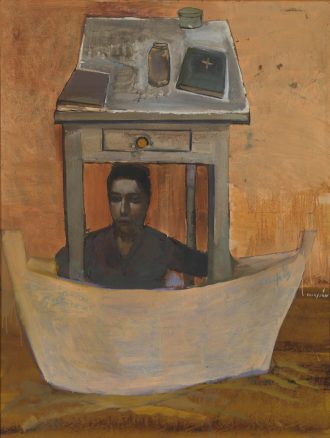
Using these means, but also through the black figure that slips in among the crowd, and that gives form to the artist’s “uneasy awareness of progress and its effects on the ordinary man as an individual”,13 and consequently, of his personal alienation, Sacaillan levels “a vital criticism by instinct”,14 at the very moment that he is setting up a powerful, iconoclastic linguistic structure, the basic aim of which is “the restoration of the subject”,15or whatever we could conceive as a reconnection with subjective identity and language, a reinvention and re-expression of diversity.
At the same time, through the portraits “Girl”, “Woman on the Terrace”, “Aery Face”, “Woman with Child”, “Big Boy”, “Villager”, “Desperate Man”, “Adornement of Sorrow” and “The Poet’s Parents”, Sacaillan appears to be revealing another dimension. The trauma no longer concerns the lost body of the society, but is related to the subject’s desire to determine his own identity. In an expression that suggests reflection and concern together, in face of the awareness of lost innocence, the loss of the past and impossibility of being reconnected with it, these people, Sacaillan’s beloved, seem to be in that borderline place that separates but also joins together the social and the existential man. The dressed and the naked man, the erotic body of the “Lovers of 2005”, “Sleep”, “Lovers in Front of the Bookcase”, or “In Paradisum”, which as Sacaillan says, “reveal desire for the other, to diminish the trauma of loneliness”. Besides, “trauma is what renders a person erotic”.16
In the artist’s view, these works “either reveal a friendly, harmonious, and not at all hostile place” (“In Paradisum”), or “they abolish space completely by absolute dedication of one person to another” (“Lovers”).17 We, in turn would say that they bring us closer to the exit from the labyrinth of replicas, images, closed spaces and the enclosure of desire. This is why, here too, space is either completely abolished, and is a “non-space”, in Sacaillan’s term, or it becomes miraculous, without showcases, aquaria or screens. With the nudes in particular, “this social reality of the postmodern culture that becomes transmuted into a desert full of mirrors, as every object gazes at its abstract essence in another, etc” as Terry Eagleton has observed18, and as is somehow revealed in the works with the viewers, ceases to exist as such. On the contrary, interpersonal contact, sexual intercourse, fantasy, and the desire of and for the other are approaching the exit from the labyrinth, while limiting or abolishing the frustration of desire and the oppression of pleasure as the basic features of “civilisation and its discontents”.19
Therefore, through what the artist describes as “anti-monumental and eccentric works”,20 Sacaillan is able to level this “animal-biological criticism”, as he calls it, a kind of anti-rhetoric, against the conditions that define the modern era, as well as against individuals who have eliminated the limits of their resistance and are carried along by this multicoloured labyrinth that deprives them of personal identity and critical thought. The difference here is that in his depiction of the “society of spectacle”, i.e. the modern society which, as in Debord, appears to “proclaim itself an enormous pot-pourri of spectacles, where whatever constituted direct experience has now been relegated to depiction and implies the non-real of the real society”,21 Sacaillan also portrays the black figure and the nude body. They are the existential man who subjectifies social depictions, “combining observation with idealisation”, in the sense of a “subjective realism that is frequently miraculous”, i.e. lending the dimension of desire and consequently of imagination to “the individual’s anxious expression as existential testimony and anguish”.22
Irene Venieraki
PhD Aesthetics and History of Art
University of Athens
Communication and Media Department
May 2009